
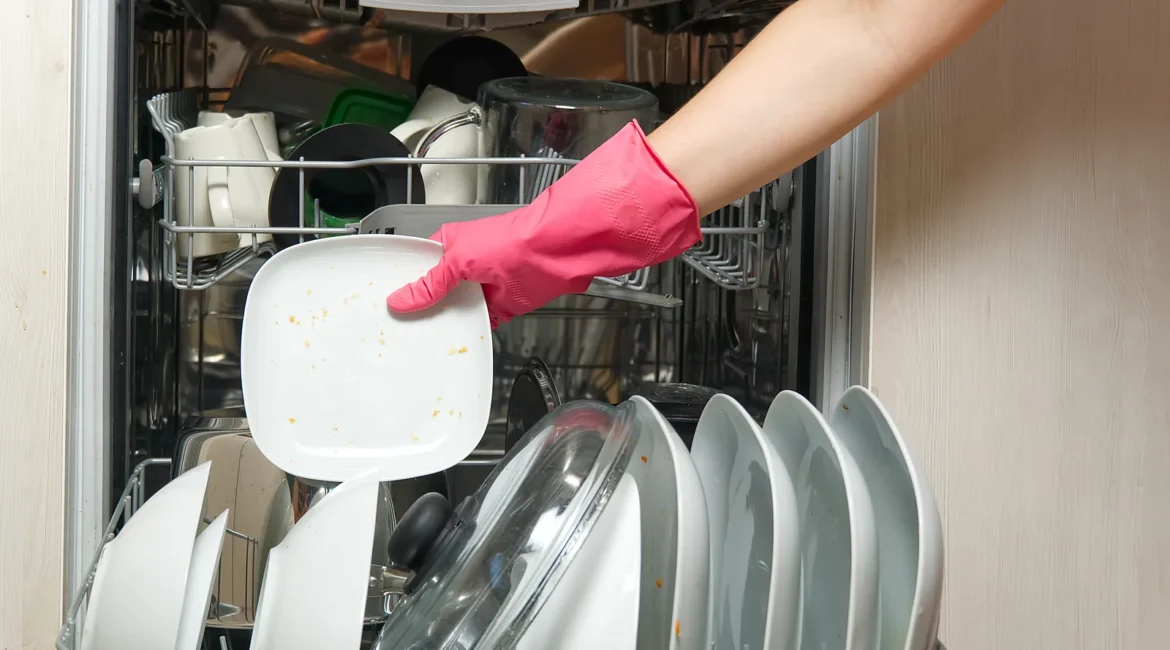
A dishwasher not heating still runs, fills, sprays and drains, so the fault can hide for weeks. You only notice the cold, wet plates, the greasy film on glasses and the tablet still stuck in the dispenser. Our engineers provide appliance repair in Ormskirk and across West Lancashire, and this is a fault we trace often. The good news is that only a handful of parts control the heat, and each one fails in a recognisable way.
How to Tell Your Dishwasher Not Heating Is a Real Fault
First, rule out the programme. Eco settings run cooler and much longer, so dishes come out warm rather than hot. That is normal, not a fault. Instead, choose the hottest intensive programme and let it run for around twenty minutes. Then pause it, wait a few seconds, and open the door carefully.
A healthy machine lets out a cloud of steam, and the inner door feels hot. If the air inside feels barely warm and the glass is cool to touch, the water is not heating. Grease on the filter and a part-dissolved tablet back that up. At that point you probably have a dishwasher not heating, rather than a drying or rinse aid problem.
The Heat Pump on Bosch, Neff and Siemens Machines
Many Bosch, Neff and Siemens dishwashers combine the heater and the wash pump in one part, often called the heat pump. A flat heating element wraps round the pump housing, so water heats as it circulates. When the element burns out, the pump still sprays, which is why the machine seems to work. These machines may show E09 on some models, although codes vary and your manual is the authority.
The heat pump also suffers when the element starts to leak current to earth. You may notice the machine tripping the electrics partway into a wash, just as the heater switches on. A dishwasher not heating that also trips the RCD points strongly at this part. Bosch owner support lists the codes for your exact model.
Separate Heating Elements and Limescale
Some machines, including many AEG models, heat water through a separate element in a tube or under the tub. Limescale coats these elements in harder water areas. The scale acts like a blanket, so the element runs much hotter inside to push heat through it. Eventually the coil breaks, and the water stays cold.
Salt and rinse aid help here, because the water softener in the base stops scale forming. Our article on how hard water destroys heating elements explains the process in more depth. If the salt light never goes out, read dishwasher salt light stays on before assuming the softener works.
The NTC Temperature Sensor
An NTC sensor is a small thermistor, a part whose electrical resistance falls as it warms up. The control board reads that resistance to judge the water temperature. If the sensor drifts, the board may think the water is already hot and switch the heater off early. You then get lukewarm washes with no error code at all. That is why a dishwasher not heating properly can puzzle owners for months.
Our engineer measures the sensor with a multimeter at room temperature, then again once the water warms. A healthy NTC shows a smooth change. A faulty one jumps, reads open circuit or barely moves. On some machines the sensor sits inside the heat pump, so the whole part changes together.
Safe Checks Before You Call Us
Switch the dishwasher off at the wall before you reach into the base. Then lift out the filters and wash them under the hot tap, because a greasy filter starves the pump and the heater of water. Check the spray arms turn freely and that nothing hangs down to block them. Top up the salt and rinse aid while you are there.
Next, run the hottest programme with the machine empty, so nothing masks the heat inside the tub. If the door glass still feels cool after twenty minutes, you have confirmed a dishwasher not heating. Do not remove the kick plate or side panels, because the heater runs on mains voltage and the wiring sits close to the water.
Pressure Switch and Flow Faults
A dishwasher will not heat unless it knows there is enough water round the element. Otherwise the element would overheat in seconds. A pressure switch or flow sensor gives that signal. When grease, scale or a split air tube stops the switch working, the board simply refuses to heat. So a dishwasher not heating can come from a blocked filter or a low fill, not a failed heater.
Clean the filters in the base and check the inlet hose for kinks before anyone calls. Low water pressure in older terraced streets around Bootle can slow the fill, which delays the heating stage too.
What Our Engineer Tests on the Visit
We test the element for resistance and continuity, then run an insulation test to find any leak to earth. Next we check the NTC, the pressure switch and the supply from the control board. Testing all of them matters, because a new heater will not fix a board that never sends power. Once we know which part failed, we give you a clear price before fitting anything.
Repair or Replace a Dishwasher Not Heating
Heat pumps, elements, sensors and pressure switches are fair repairs on most machines with a sound tub and door. If the main board has failed alongside the heater, the sums become closer, so we talk you through them honestly. Our dishwasher repair engineers carry common parts, and our Bosch appliance repairs cover the heat pump faults described above. A dishwasher not heating also struggles to dry, which why your dishwasher is not drying dishes explains.
We carry out dishwasher repair Shevington households book, and our home town team covers dishwasher repair Ormskirk customers every week. We also handle dishwasher repair Skelmersdale families rely on as autumn brings heavier pans and roasting tins.
Our call out fee is just £30, and we refund it against parts or a replacement domestic appliance, so you get great value for money. If our engineer can fix your dishwasher on the spot, we charge a fixed £60 labour plus the cost of parts. New parts come with a 12 months warranty.
Cold, greasy dishes after every cycle usually mean a dishwasher not heating, and the fix is often simpler than you fear. Call us on 01695 768 738 and we will test the heater circuit properly.

