
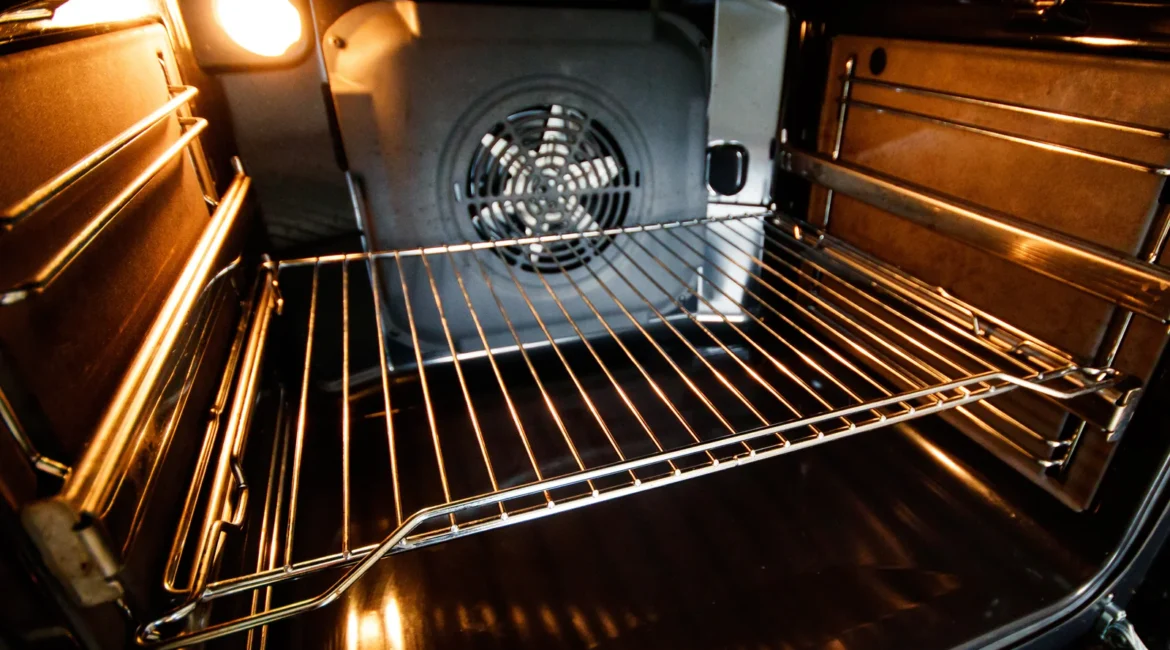
With darker evenings drawing in, the oven starts working harder, and an oven fan not working shows up quickly. Roast potatoes brown on one side only. Cakes rise in a dome and stay pale on top. The bottom shelf burns while the top shelf barely cooks. We provide appliance repair in Ormskirk and across West Lancashire, and this fault is one of our regular autumn calls. Here we explain which parts make the fan turn, why they stop, and how to tell a fan fault from other heating problems.
How to Tell if Your Oven Fan Not Working Is the Real Problem
A fan oven has a round heating element at the back, wrapped around a metal fan blade. The fan pulls air through that element and pushes hot air around the cavity. That is what gives fan ovens their even heat. When the blade stops, the element still glows, but the heat stays trapped at the back of the oven.
So look through the glass while the oven warms up on a fan setting. You should see the blade spinning behind the slots in the rear panel. If it sits still, you have an oven fan not working. If it spins but the oven stays cold, the problem lies with the element or its controls instead. Those are two different repairs, so it helps to know which one you have.
The Fan Motor and Why It Seizes
The motor sits behind the back wall of the oven, outside the cavity. Its shaft passes through the wall to drive the blade. Because it lives right next to a hot oven, its bearings slowly dry out. Grease from years of roasting also creeps along the shaft. Eventually the motor runs slower, then stiffens, and finally stops altogether.
On many Bosch, Neff and Siemens ovens, the first sign is a fan that starts late or turns sluggishly when cold. Later it may hum briefly and then stall. Once a motor has seized, freeing it by hand rarely lasts, because the bearing surfaces are already worn. We replace the motor rather than gamble on a short-term fix.
Fan Element Versus Fan Motor
People often mix these two parts up, but they fail in very different ways. The fan element is the heating ring. If it burns out, the blade still spins but blows cool air, so the oven never reaches temperature. The fan motor is the drive. If it fails, the element still heats, but nothing moves the air. That uneven result is the classic sign of an oven fan not working.
Our article on fan oven not circulating heat looks at airflow problems in more depth. For an oven that will not heat at all, our piece on why your electric oven is not heating up correctly covers the element side of things.
The Thermal Cut-Out and Overheating
A thermal cut-out is a safety switch that breaks the power when part of the oven gets too hot. With an oven fan not working, heat builds up behind the rear panel instead of spreading. That trapped heat can trip the cut-out, so the oven shuts down part way through cooking. Some cut-outs reset as they cool, so an oven fan not working can look like an oven that randomly switches itself off. Others stay open and need replacing.
Most ovens also have a separate cooling fan near the top. It blows air across the controls and out above the door, and it often runs on after you switch off. That fan is a different part. A failed cooling fan can also trip the cut-out, so we always check which fan has actually stopped.
Timers, Clocks and Control Faults
Sometimes the motor is fine, but it never receives power. On many ovens the clock must be set before any function will run. After a power cut, the display may flash and the oven stays idle until you set the time. If your oven fan not working coincides with a blinking clock, try that first. Our guide to an oven timer fault explains how to release a locked oven.
On AEG and other modern ovens, a relay on the control board switches the fan motor. If that relay fails, the fan never starts even though the lights and element work normally. That is less common than a worn motor, but we test for it every time.
Safe Checks Before You Call Us
First, switch the oven off at the cooker isolator switch, which is the large switch on the wall near the oven. Let the oven cool completely. Then check whether the clock needs setting and whether you have chosen a fan function. Some settings, such as conventional or grill, do not use the rear fan at all. Never remove the rear panel or touch the wiring yourself. Electrical Safety First has useful advice on the risks of DIY work on mains appliances.
How Our Engineers Test an Oven Fan Not Working
With the oven isolated, we remove the back panel and spin the blade by hand. A healthy motor turns freely with no grinding. Then we take a resistance reading across the motor windings with a multimeter, and an open circuit means the motor has burnt out. We test the cut-out for continuity and check the fan element too. Finally, we power the oven safely and measure the voltage reaching the motor. That last step shows whether the control side is doing its job.
Repair or Replace the Oven
In our experience, an oven fan not working is usually well worth repairing. A new fan motor costs far less than a new built-in oven, and a replacement built-in oven must also fit your existing cabinet opening. We carry out electric oven repair on all the main brands. Our electric oven repair Crosby visits often turn up seized motors on busy family ovens. Likewise, electric oven repair Rainford calls and electric oven repair Standish jobs frequently involve timer and cut-out faults.
Our call out fee is a low £30, and we refund it against parts or a replacement domestic appliance, which makes it great value. If our engineer can fix your oven on the spot, we charge a fixed £60 labour plus the cost of parts. New parts also carry a 12 months warranty.
An oven fan not working will only get worse as the cooking season builds. If your oven is cooking unevenly, call us on 01695 768 738 and we will send a local engineer to find the cause.

