
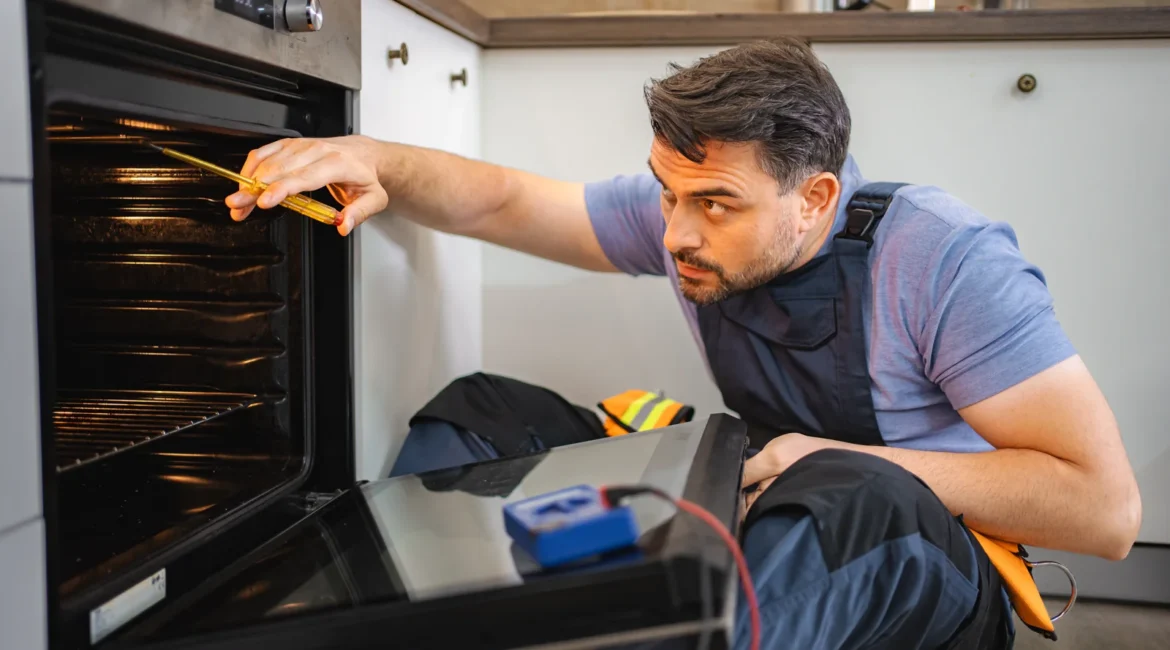
Few kitchen faults confuse people as much as an oven that sounds normal but never gets hot. The fan whirs and the light comes on, yet the food sits there raw. In most cases the culprit is the fan oven element, the circular heating ring behind the back panel. We replace these parts every week as part of our appliance repair in Ormskirk and West Lancashire work. Below we explain how the ring works, why it fails and what you can safely check.
How a Fan Oven Element Works Behind the Back Panel
Look at the rear wall of your oven and you will see a slotted metal cover. Behind it sits a fan blade driven by a small motor. Wrapped around that fan is the fan oven element, a metal tube bent into a ring. Inside the tube, a coiled wire carries current and glows hot. A packing of fine mineral powder holds the wire in the centre so it never touches the outer sheath.
On the fan setting, the motor draws air from the middle of the oven. It then pushes that air across the hot ring and around each shelf. That is why fan cooking runs cooler and more evenly than the old top and bottom method. Meanwhile the thermostat, the sensor that holds your chosen temperature, switches the ring on and off.
Fan Runs but No Heat Is the Classic Sign
The fan spins and the light works, but the oven never climbs past lukewarm. A working fan tells us the selector is passing power to that circuit. So the fault usually sits further along, in the ring itself, its connections or the thermostat.
A quick test narrows it down. Switch to the conventional setting, shown as a square with a line at the top and bottom. If the oven heats on that setting but stays cold on fan, the fan oven element becomes the prime suspect. On many Bosch, Neff and Siemens ovens, the top and bottom elements run on separate circuits. They keep working even after the ring fails.
Why the RCD Trips When the Oven Warms Up
Sometimes the ring fails more dramatically. The oven runs for a minute, then the kitchen goes dark. That is the RCD, or residual current device, the safety switch in your consumer unit that cuts power when current leaks to earth. A hairline crack in the sheath lets moisture into the powder packing. Once that powder soaks up damp, current leaks from the coil to the casing.
We see this more in autumn, when the heating comes on and evening cooking fills kitchens with steam. Coastal homes in Southport and Formby can be damp too. An oven left unused for a week may trip once, then settle as it dries. Even so, a healthy ring should never leak to earth. Treat any tripping as a warning, and follow the advice from Electrical Safety First about never resetting a safety switch over and over.
Signs of Damage You Can Spot Yourself
First switch the oven off at the cooker isolator and let it cool fully. Then remove the shelves and shine a torch through the slots in the back panel. A healthy fan oven element looks even and dull grey. A failed one may show a blister, a split or a white powdery patch where the sheath has burst.
Some owners hear a loud crack, then smell burning, and the fan setting goes dead. That sound often marks the coil arcing through its casing. Please do not touch the ring or try to bend it back. A food spill on the back panel can smoke, but it will not stop the heat, so the two faults are easy to tell apart.
How Our Engineers Test the Element
A visual check only tells part of the story, so we confirm every diagnosis with a meter. After isolating the oven, we undo the screws and lift the back panel away. Then we test the ring with a multimeter on its resistance setting. A typical ring reads a few tens of ohms. An open circuit reading tells us the coil has snapped.
Next comes an insulation test, which checks for leakage between the coil and the sheath. A basic meter can miss this, because the leak may only appear at mains voltage. Our insulation tester applies a higher test voltage, so a low reading confirms the cause of the tripping. We also check the terminals and wiring, because a burnt connector can mimic a dead ring.
Replacing a Fan Oven Element Safely
Once we confirm the fault, fitting a new fan oven element is usually a tidy job. We disconnect the old ring, release its screws and lift it off the fan housing. Then we fit the new part, with fresh connectors if the old ones show heat damage. Finally we run the oven on full heat while we check current draw and earth leakage.
Replacement rings vary in wattage, diameter and terminal layout, even between ovens that look alike. A generic ring with the wrong rating can overload the wiring or deliver sluggish heating. On many AEG and Neff ovens, we trace the correct part from the rating plate on the oven frame.
Fan Oven Versus Conventional Settings
Plenty of people rarely use the fan setting, so they only notice the failure at Sunday lunch. A fan on its own, or a fan in a circle, runs the rear ring. The conventional symbol uses the top and bottom elements with no fan. A fan with a line under it often pairs base heat with moving air for pizza.
Because fan cooking works at a lower setting, the rear ring does most of the work in a modern oven. It cycles on and off many times during one roast. Every cycle stresses the coil as it expands and cools, so the fan oven element often fails before the grill. Our piece on why your electric oven is not heating up correctly covers other causes. We also explain a fan oven not circulating heat when the motor is to blame.
Repair or Replace the Whole Oven
In most cases, a new ring is well worth fitting. The part costs a fraction of a new oven, and the rest of the appliance is often sound. We think harder when the thermostat, door seal and fan motor are all failing together. Even then, we give you an honest view before you spend anything.
We offer electric oven repair Aughton families rely on, along with electric oven repair Tarleton and electric oven repair Rufford visits. Every electric oven repair follows the same careful tests before we fit any part.
Our call out fee is a low £30, which we refund against parts or a replacement domestic appliance. That makes it great value for money. If our engineer can fix your oven on the spot, we charge a fixed £60 labour plus the cost of parts. New parts also carry a 12 months warranty.
If your fan oven element has failed or keeps tripping the power, switch the oven off at the isolator. Then call us on 01695 768 738 and we will book an engineer to get it heating again.

